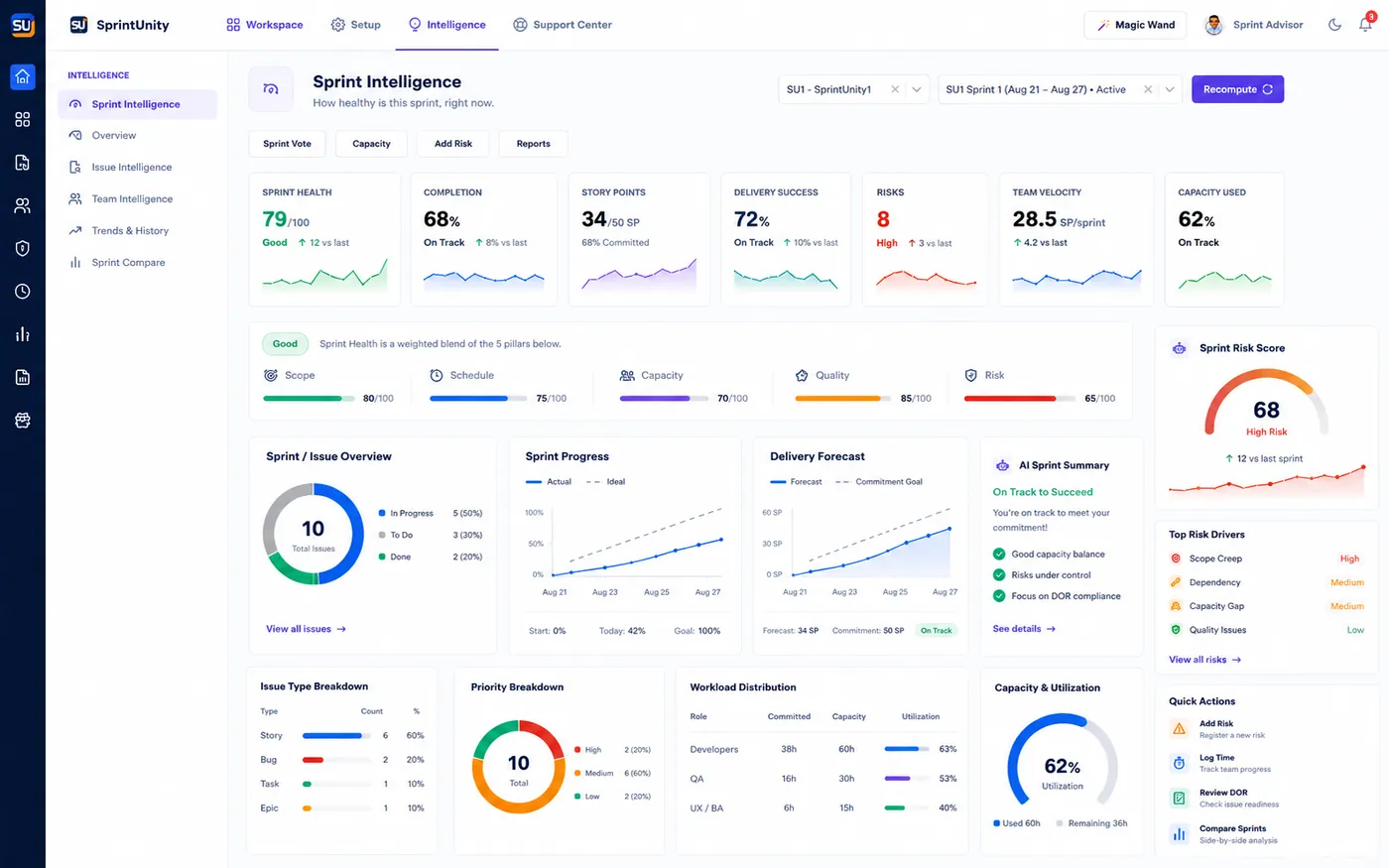
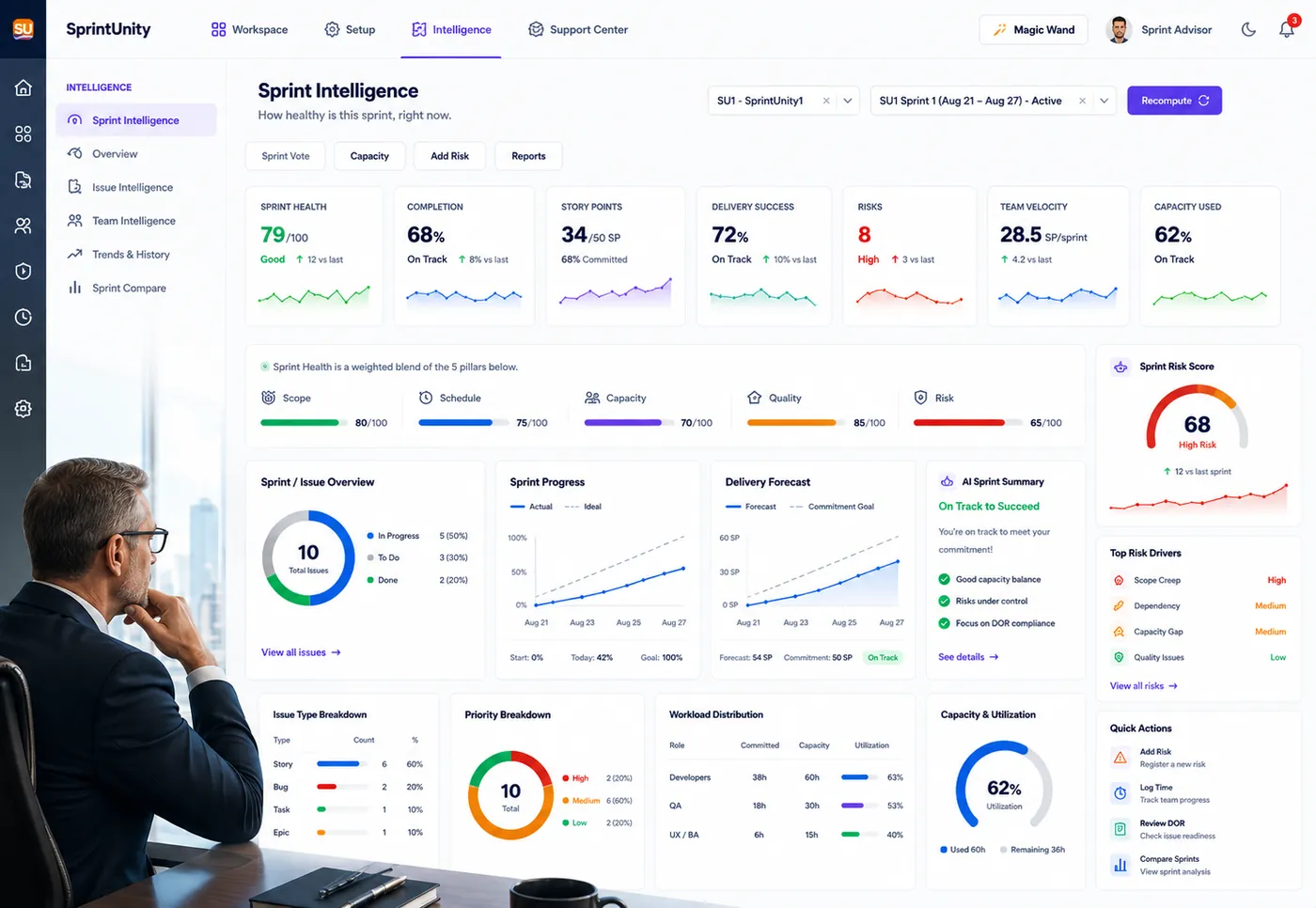
Sprint Intelligence
Understand sprint health through Scope, Schedule, Capacity, Quality and Risk.
Explore feature →Plan smarter. Commit realistically. Detect risks early. Deliver with confidence.







Real friction points in Agile delivery, and the module built to close each one.
Story points come from one person's guess, not the team's real judgment.
Everyone estimates independently, inside the issue, before a number gets locked in.
Sprints get committed before anyone checks whether the team actually has the hours.
Dev and QA availability is visible before you commit, not discovered after.
Delivery risk usually surfaces in the last few days of the sprint, when it's too late to react.
Delivery, Capacity, Quality and Dependency risks are flagged early enough to act on them.
Stories enter the sprint that were never really ready — vague acceptance criteria, missing details.
Configurable readiness rules catch stories before they're pulled into a sprint.
Every retro starts from scratch because there's no easy way to compare this sprint to the last five.
Scope, schedule, capacity, quality and risk side-by-side across up to 3 sprints.
Contribution and effort are invisible outside of gut feel, which makes evaluations feel arbitrary.
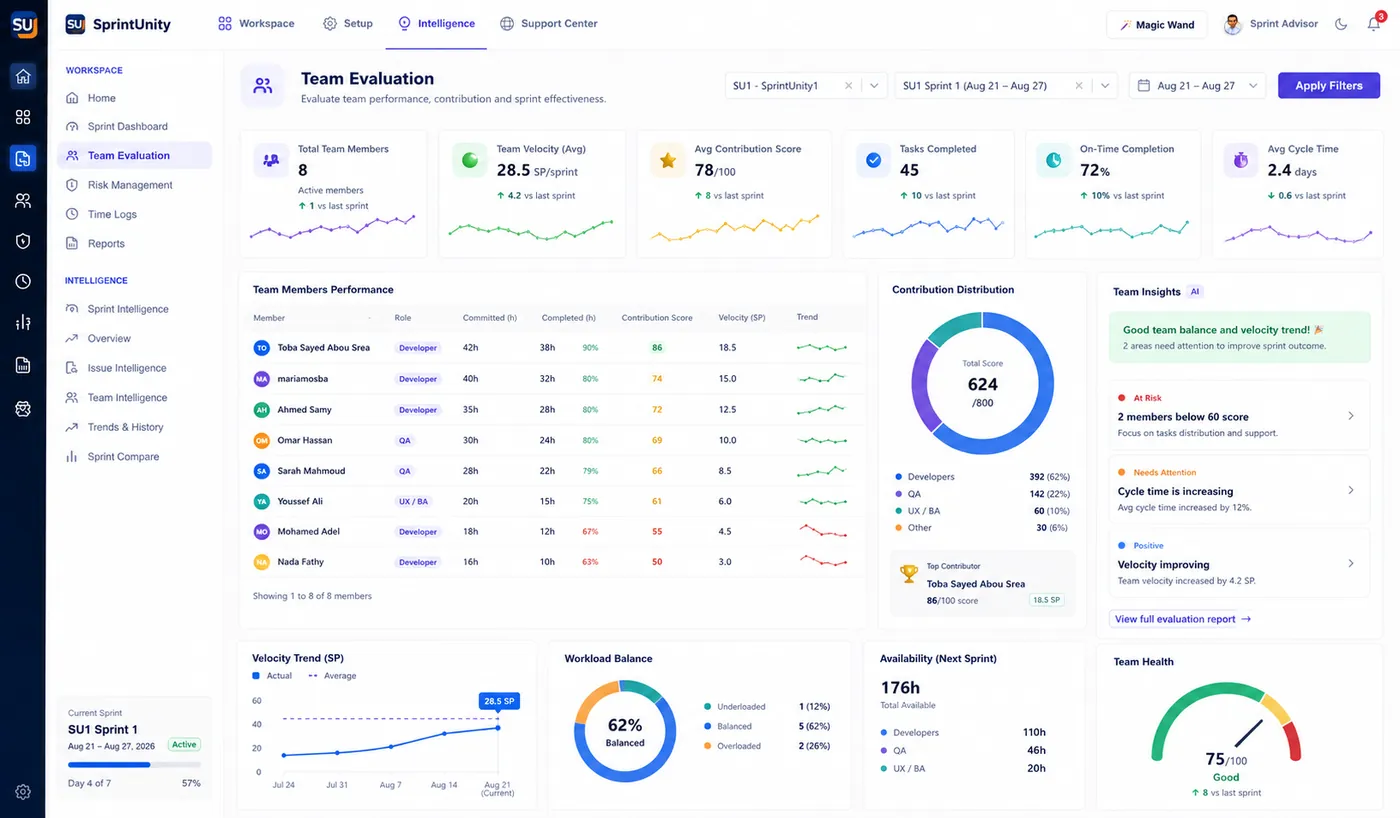
A guided, evidence-based view of individual and team contribution over time.
Dev and QA hours get logged after the fact, if at all — so real capacity is always a guess.
Every dev and QA hour is logged against the issue it belongs to, feeding straight back into Sprint Capacity.
Contribution data lives in a single evaluation snapshot — there's no ongoing view of who's doing what.
Ongoing contribution matrices and analysis by member, issue type and sprint — beyond a single report.
Turning sprint data into something you can present to leadership takes hours of manual copy-paste.
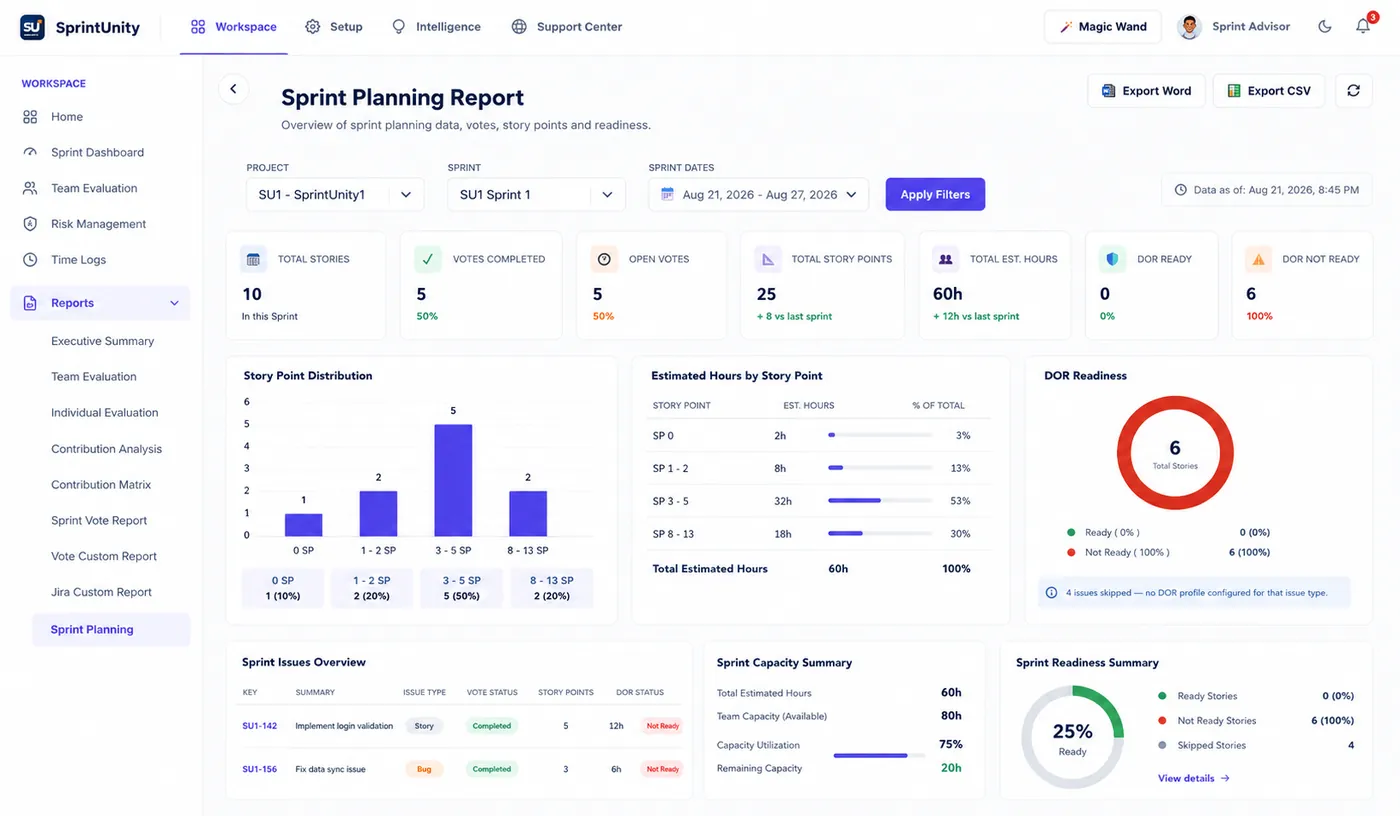
Executive summaries, evaluation and planning reports generated directly from real data, ready to export.
Understanding why a score looks the way it does still means digging through every panel yourself.
An AI assistant built into every panel that explains what the data means and why, on demand.
"Health dropped because DOR compliance fell 10% this sprint."
Without granular permissions, anyone can vote, close a sprint, or see risk data they shouldn't.
Granular permissions per project — control exactly who can vote, close sprints, view reports or manage risk.
Too many actions need to be taken every sprint, scattered across boards, backlogs and reports with no single place to see them.
Every action ranked into Critical, Attention, Awaiting My Input and Assigned to Me, in one prioritized list.
Getting an honest read on portfolio delivery means opening every project and piecing it together by hand.
Portfolio Health, Delivery, Capacity, Quality and Dependencies rolled up into one executive view, with the Top 5 Delivery Concerns already ranked.
SprintUnity brings intelligence and clarity to every step of your sprint journey.
Understand sprint health through Scope, Schedule, Capacity, Quality and Risk.
Explore feature →See team availability, development capacity and QA capacity before committing.
Explore feature →Validate whether stories are ready to enter the sprint with configurable rules.
Explore feature →Compare up to 3 sprints and identify patterns across delivery performance.
Explore feature →Detect Delivery, Capacity, Quality and Dependency risks before they become blockers.
Explore feature →Turn sprint information into clear, exportable reports for delivery decisions.
Explore feature →Estimate together inside the issue itself — story points, t-shirt sizes and dev/QA hour estimates, with live team visibility and full vote history.
Explore feature →An AI assistant built into every panel that explains what the data means and why a score looks the way it does, on demand.
Explore feature →Assess individual and team contribution across sprints with a guided setup and clear historical comparisons.
Explore feature →Granular permissions per project — control exactly who can vote, close sprints, view reports or manage risk.
Explore feature →Track dev and QA hours against each issue, feeding directly back into sprint capacity calculations.
Explore feature →Every action the sprint needs — Critical, Attention, Awaiting My Input and Assigned to Me — ranked in one prioritized list.
Explore feature →An executive overview of portfolio delivery health — Portfolio Health, Delivery, Capacity, Quality and Dependencies in one screen.
Explore feature →An end-to-end lifecycle that turns Jira data into smarter sprint outcomes.
Configure your workspace & set your Definition of Ready
Estimate and size the work
Build a realistic sprint commitment
Track progress and catch risks early
Analyze performance and outcomes
Turn insights into action
Insights and lessons learned feed back into Setup and Planning, making every sprint smarter than the last.
Turn Jira's sprint data into a clear view of capacity, readiness, health and delivery risk.
SprintUnity gives every role the clarity they need to plan, execute and deliver with confidence.
Estimate, plan and build with clarity. Track work, log time and stay aligned.
Balance workload, track progress and keep your team focused.
Run healthier sprints with data-backed insights and smarter planning.
Validate scope, capacity and delivery confidence before commitment.
Monitor team health, performance and delivery risk in real time.
Get organization-wide visibility and drive continuous improvement.
Plan with capacity. Commit with confidence. Detect risks before they become delivery problems.